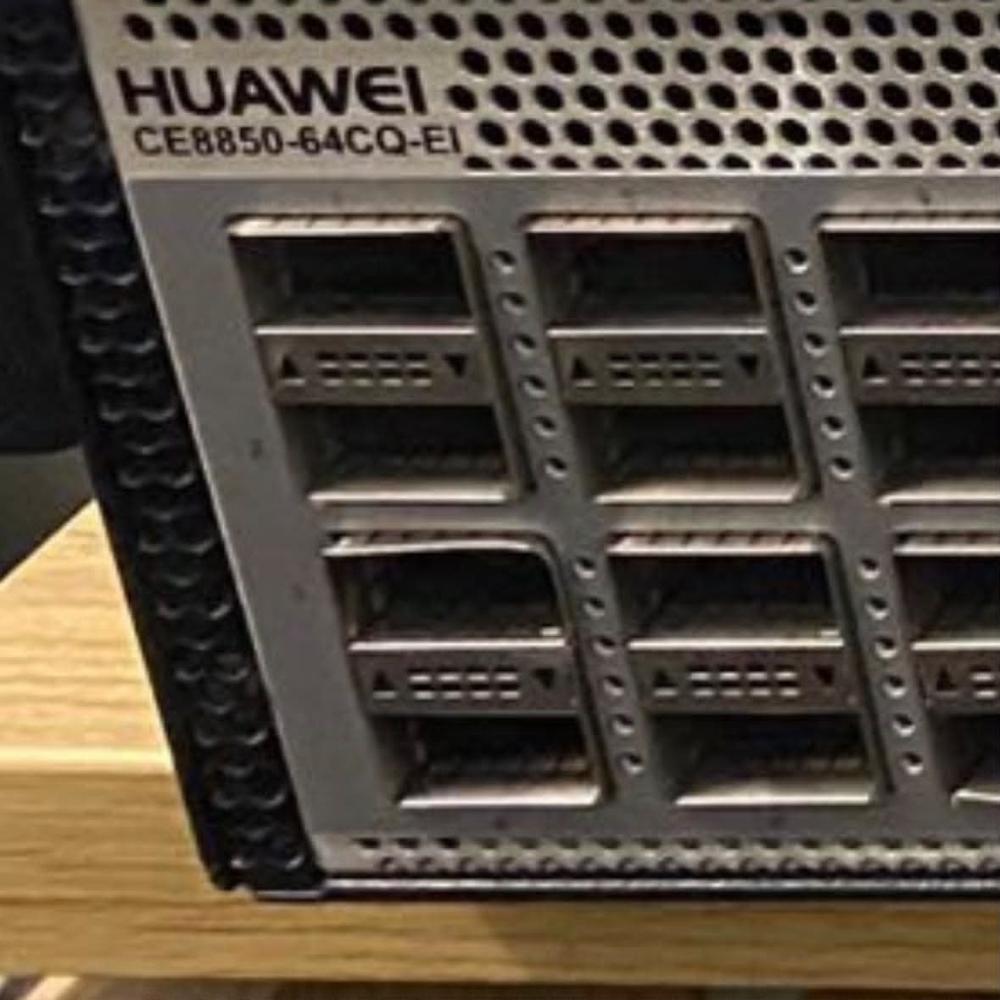
About HUAWEI CE8850-64CQ-EI
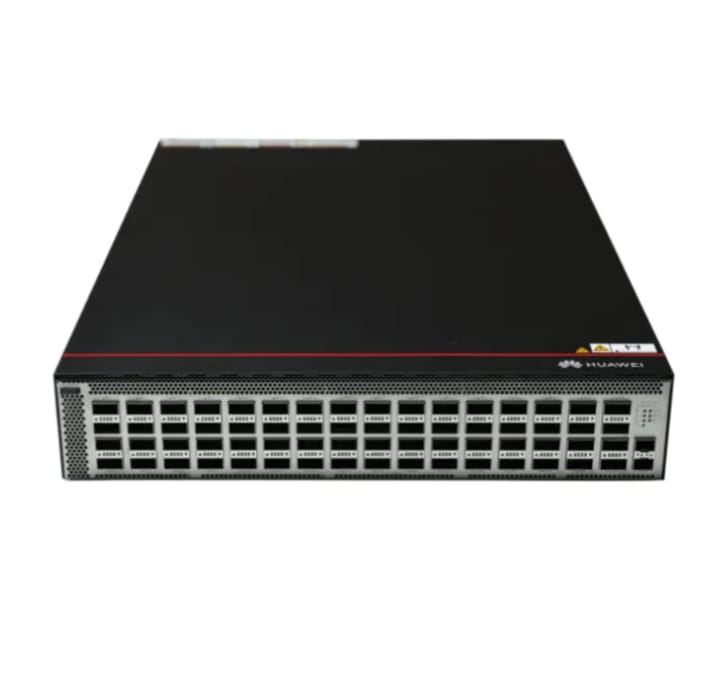
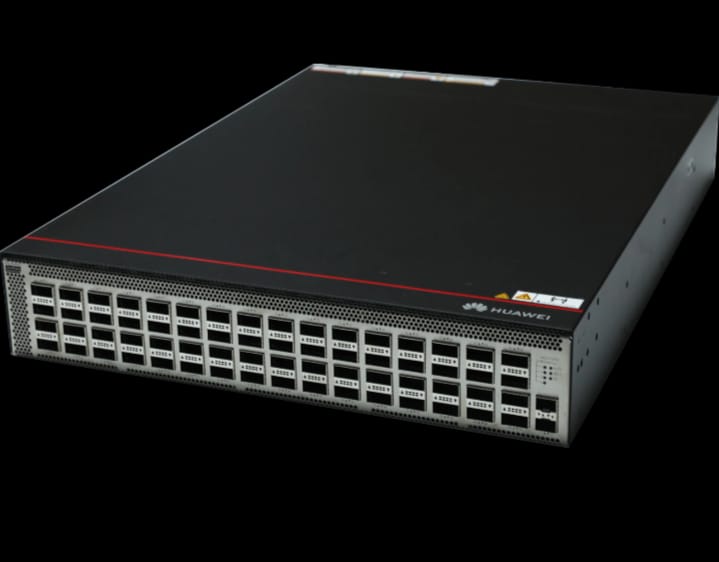
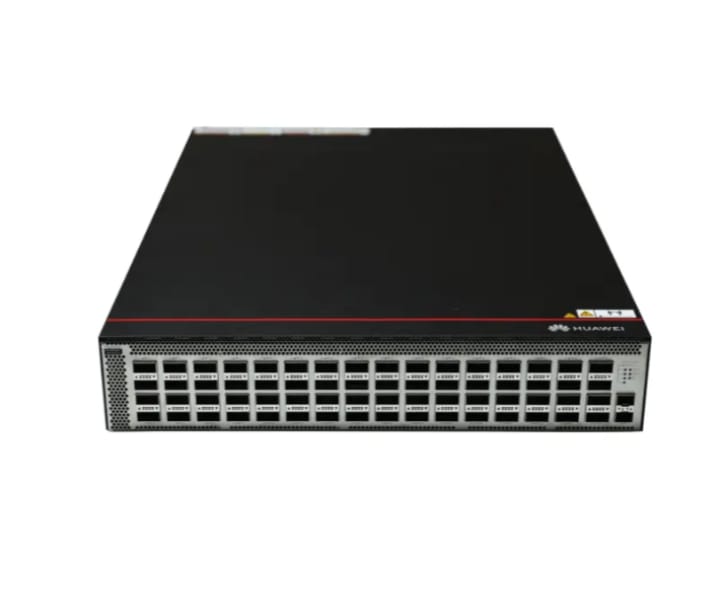
- Form Factor / Chassis Height: 2U rackmount (Dimensions: 86.1 mm x 442.0 mm x 600.0 mm)
- Weight: 12 kg (26.46 lb) [excluding modules] / ~22.2 kg [full configuration]
- Downlink / Service Interfaces: 64 x 40GE/100GE QSFP28 optical ports (each 100GE port can split into 4 x 10GE or 25GE ports, or 2 x 50GE ports)
- Management & Console Ports: RJ45 console port, USB port, and management interfaces
- Switching Capacity: 12.8 Tbps
- Forwarding Performance: 4,482 Mpps
- Processor & Memory: 1.5 GHz 8-core CPU, 4 GB DRAM, 64 MB NOR Flash, 4 GB NAND Flash (earlier versions featured 2 GB NAND)
- Power Supply: 2 pluggable power module slots supporting 1+1 redundant AC/HVDC or DC power modules (1200W rated)
- Cooling: 3 fan module slots with 2+1 fan redundancy (supporting port-side intake/front-to-back or exhaust/back-to-front airflow)
- Typical / Max Power Consumption: ~376W to 629W (up to 965W under specific high-load configurations)
- Key Features: Supports up to 16-switch stacking, M-LAG, VXLAN/BGP-EVPN virtualized hardware gateway, and Open Programmability System
Ultra-High Density and FlexibilityThe HUAWEI CE8850-64CQ-EI provides 64 QSFP28 ports, each capable of 40GE or 100GE connectivity. With port-splitting, networks can scale up to 256 10GE connections, accommodating diverse requirements in evolving data centers or enterprise core networks without sacrificing performance.
Reliable, Redundant Architecture This switch is designed for continuous operation with dual hot-swappable power modules (supporting AC/HVDC or DC) and 2+1 redundant fan modules. It ensures high availability and resilience for critical network infrastructures, supporting front-to-back or back-to-front airflow for flexible deployment.
Powerful Performance and ScalabilityWith a 1.5 GHz 8-core CPU, ample memory, and a 12.8 Tbps switching capacity, the CE8850-64CQ-EI is tailored for high-traffic environments. Its ability to stack up to 16 switches or enable advanced features like VXLAN/BGP-EVPN makes it suitable for future-proof network buildouts.
FAQ's of HUAWEI CE8850-64CQ-EI:
Q: How is the HUAWEI CE8850-64CQ-EI typically deployed in data centers or enterprise networks?
A: The HUAWEI CE8850-64CQ-EI is commonly used as a core or spine switch in large-scale data centers and enterprise networks, providing high bandwidth aggregation and flexible port breakout for seamless connectivity and layering.
Q: What benefits does the switch's flexible port configuration offer?
A: Its 64 QSFP28 ports support 40GE or 100GE speeds, and each can split into multiple lower-rate sub-ports. This feature allows for granular scaling, accommodating a wide range of devices and network expansion requirements without additional hardware.
Q: When do I need to consider redundant power and fan modules for this switch?
A: Redundant power (1+1) and fan (2+1) modules are essential during mission-critical operations or in environments demanding maximum uptime. These redundancies mitigate risks of single-point failures and promote continuous service delivery.
Q: Where can the HUAWEI CE8850-64CQ-EI be installed, and what are its mounting requirements?
A: This switch is optimized for 2U rackmount installation in standard server racks. Its dimensions (86.1 mm x 442.0 mm x 600.0 mm) ensure compatibility with common data center and enterprise rack configurations.
Q: How does the switch's advanced management and console interfaces assist with network operations?
A: With an RJ45 console port, USB port, and dedicated management interface, the switch provides flexible local and remote management, simplifying operations such as configuration, updates, and troubleshooting.
Q: What is the operating temperature range for this network switch?
A: The device is designed to operate reliably within 0C to 40C, making it suitable for most controlled data center and network room environments.
Q: What are the energy considerations for the CE8850-64CQ-EI, and how much power does it consume?
A: Depending on configuration and usage, the switch's typical power consumption ranges from approximately 376W to 629W, with a maximum of up to 965W, so appropriate power provisioning is necessary for reliable operation.






 Send Inquiry


 Send Inquiry
 Send Inquiry
 Send SMS
